Kingdom Hearts is a role-playing game that encompasses various worlds within the Disney universe. This article will use Simon Egenfeldt-Nielsen Et Al’s discussion on video game narratives to discuss how Kingdom Hearts develops its narrative through cut-scenes and dialogue, and what narrative style the game most closely resembles
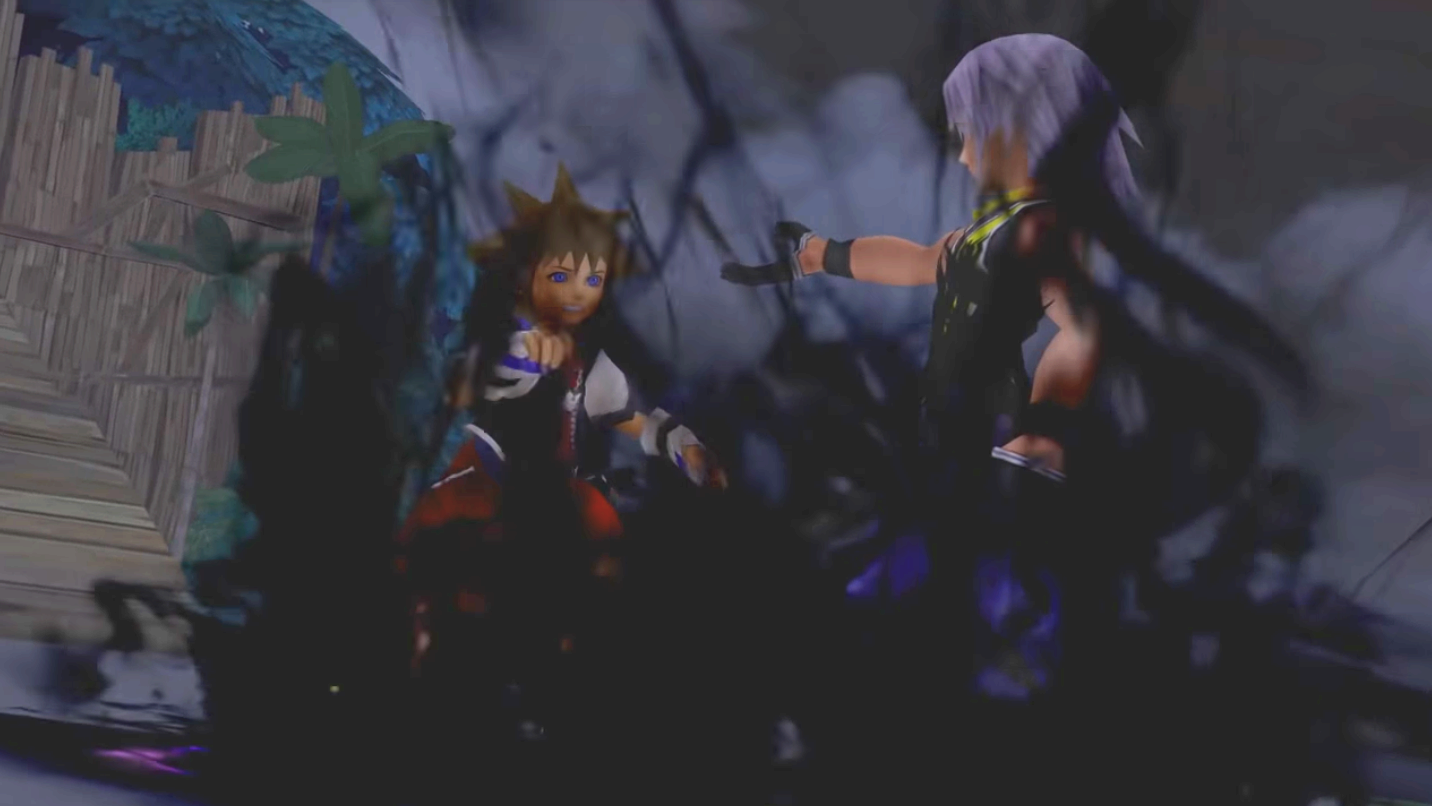
Kingdom Hearts has received both praise and criticism from the gaming community throughout the years, with no small part of that criticism coming from its cut-scene-driven gameplay. As soon as the player begins a new game, they are shown a 3-minute long cut-scene that provides little to no exposition and acts more as a music video for the game’s main theme song. Egenfeldt-Nielsen states that “…cinematics are used to convey useful information…,” and aside from that introductory cut-scene , all subsequent cut-scenes in Kingdom Hearts serve to convey a variety of information to the player including introducing new surroundings, showing character development, and telling the story of Kingdom Hearts (Egenfeldt-Nielsen, pg. 177). In Figure 1, the player sees a friend of Sora, Riku, talk about not being afraid of “the darkness,” an evil entity that devours worlds and manifests itself through enemies called “The Heartless.” This scene comes after a previous cut-scene where Sora’s other friend, Kairi, made comments about Riku acting differently
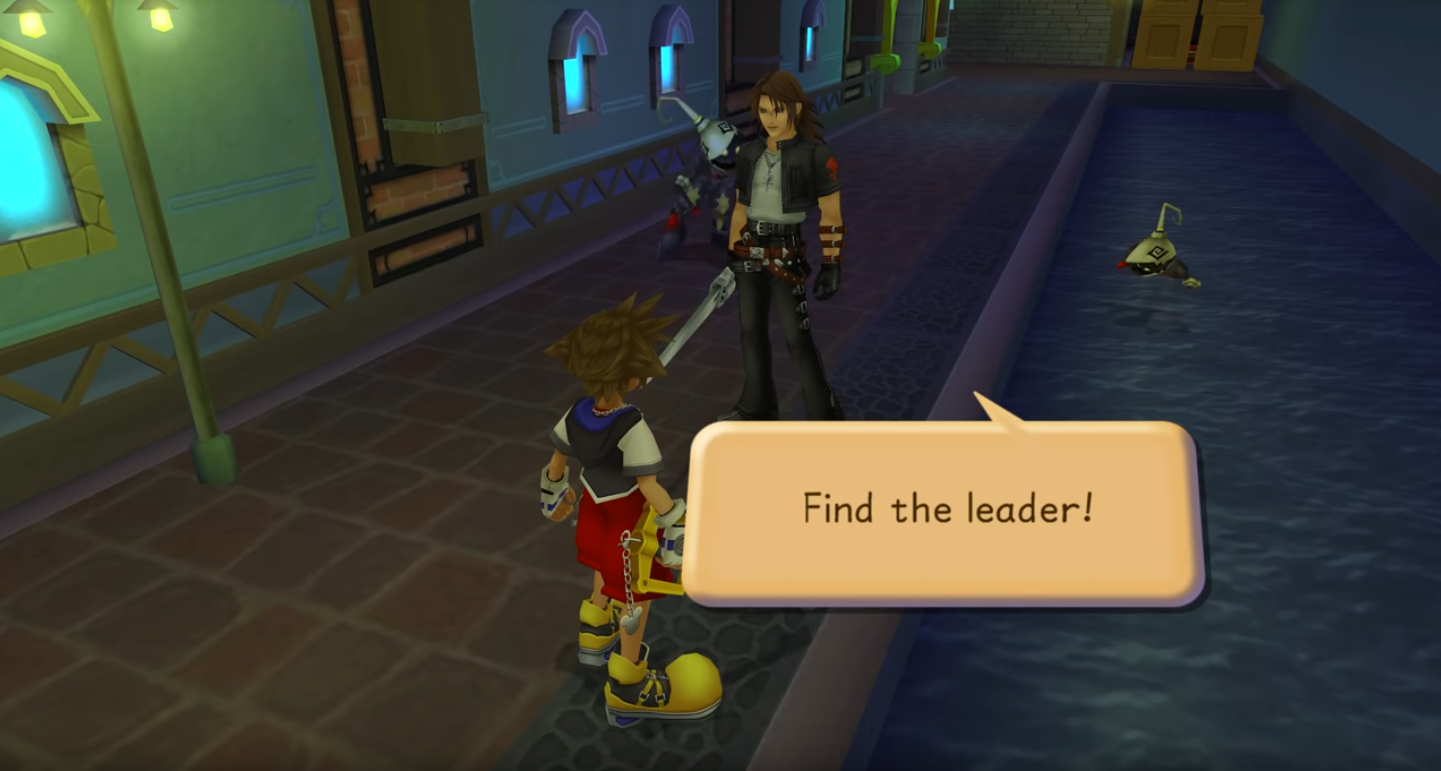
Cut-scenes are Kingdom Hearts’ preferred method of providing information to the player, but in addition to cut-scenes, it uses dialogue between characters to move the story forward. In Figure 2, the character Leon tells Sora to find the leader of The Heartless. From the information provided, players are able to deduce that they need to find and defeat a boss to continue through the story. By interleaving dialogue around cut-scenes, Kingdom Hearts presents their narrative without tiring the player with the same storytelling medium
Of the narrative types discussed by Egenfeldt-Nielsen, Kingdom Hearts falls into a mix of both evoked narratives and embedded narratives. These two narratives are described as “…a world that is known to players through other works of fiction”, and “… a memory palace whose contents must be deciphered as the player tries to reconstruct the plot” (Egenfeldt-Nielsen, pg. 200). This description of evoked narrative gives the idea that there is little left for the player to discover since they are familiar with the world, while embedded narrative tells us that the player must unravel this unknown world through gameplay. They may appear to be polar opposites, but despite that Kingdom Hearts encompasses both. Fans of the series know there is much to discover about the world of Kingdom Hearts, so how exactly is it an envoked narrative? The worlds of Disney characters are the envoked aspect of the game’s narrative while the darkness, and everything else that is unique to the Kingdom Hearts world, is the embedded narrative that players must unravel.
For fans of high intensity, non-stop gameplay, Kingdom Hearts’ cut scenes will undoubtedly cause frustration. But for those who enjoy cinematic experiences and rich storytelling, Kingdom Hearts remains one of the most memorable gaming franchises in recent history
Sources:
[1] “Narrative.” Understanding Video Games: The Essential Introduction, by Simon Egenfeldt-Nielsen, Et. Al, Routledge, 2007, pp. 169-204.
 [Subject To Change]