Limbo is a 2D monochrome puzzle-platformer where the player controls a young boy who has awoken in a mysterious world. It is up to the player to use their ingenuity and creativity to solve puzzles and advance through this world while facing the limitations imposed by the game’s developers. In this article, we will explore how Tracy Fullerton’s discussion of rules and resources in her book, Game Design Workshop: A Playcentric Approach to Creating Innovative Games, apply to the rules and resources players face in Limbo [1].
Of the many resources discussed by Fullerton, the ones most prominent in Limbo are lives, time, and inventory. Figure 1 provides an excellent example of all three of these resources working in tandem. In this puzzle, the player must figure out how to use their crates to escape from the approaching saw before it kills them, forcing them to replay the puzzle. What I found enjoyable, and frustrating, about this puzzle was that in addition to having to complete the puzzle before the saw kills the boy, the buttons that released the crates needed to be pressed at the correct time in order to succeed. The first button pressed begins releasing the first crate, but it also begins the saw’s movement towards the player. The player is forced to be patient and time the second button press correctly while the saw gets ever closer to killing the boy.

Fullerton mentions power-ups as one of the many resources found in games but fails to mention de-buffs, which begs the question of whether or not de-buffs should be classified as a resource or an obstacle. A unique element of Limbo that transforms the game’s movement rules is the mind controlling worm. This worm, shown resting on the boy’s head in figure 2, is an unavoidable de-buffs that forces the player to move in only one direction and prevents the player from coming to a stand still. Receiving this de-buffs forces the player to change their play-style by removing hazards before the worm controls them and managing their movement speed to avoid other hazards. The worm also opens access to two new resources for the player: light and the worm-eating creatures. If the player walks into a lighted area while possessed, the worm begins to burn in the sunlight and forces the player to change their direction. The player’s ultimate goal while possessed is to strategically change their movement direction with the light so that they can get close enough for the black creatures to eat the worm possessing them.
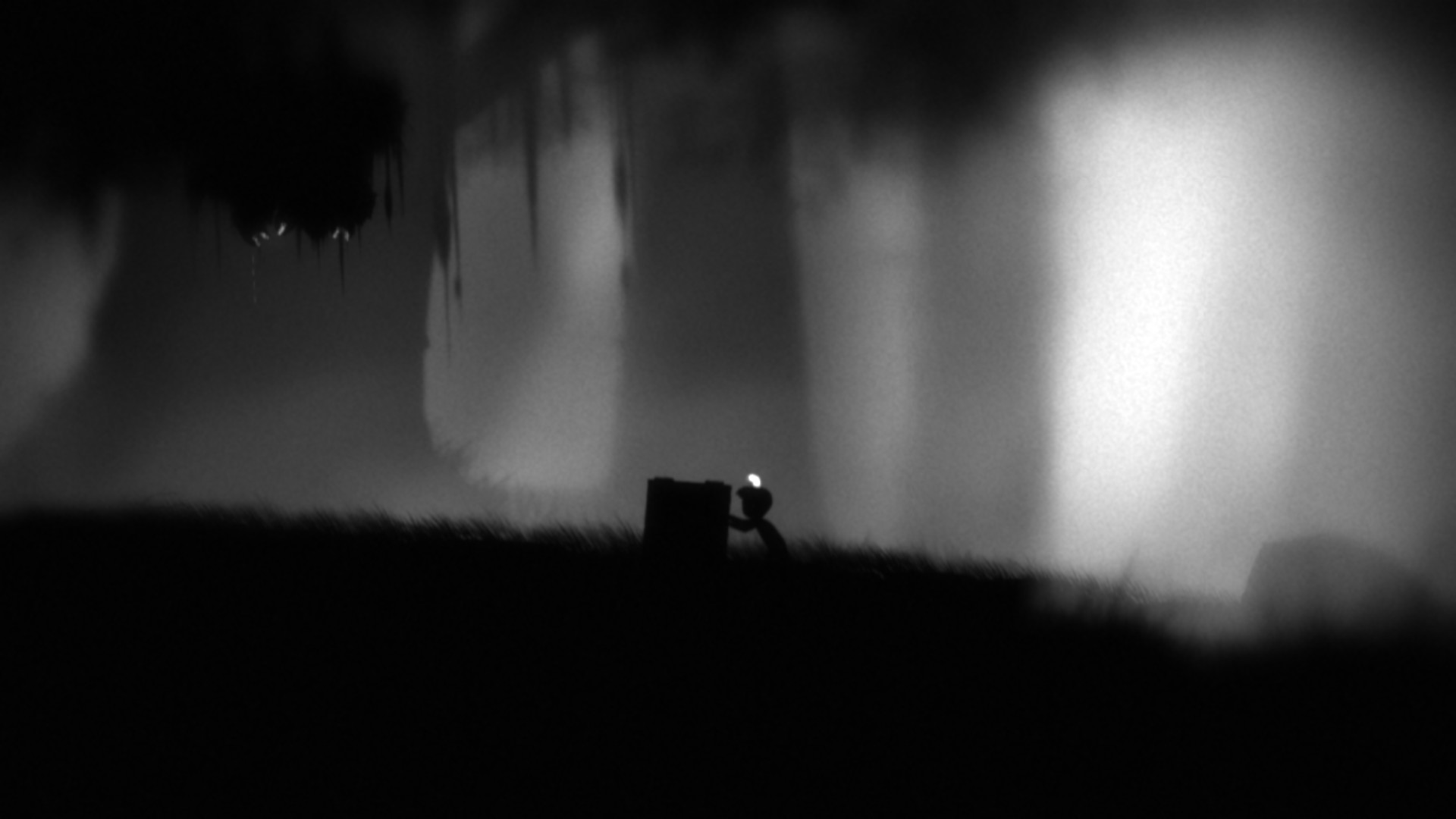
Fullerton provides the following definition for resources: “resources are assets…that can be used to accomplish certain goals” (Fullerton, 78). Based on the definition given, I would argue that the worm de-buffs is more of an obstacle than a resource. It provides no benefit in accomplishing any specific goal and only hinders the players ability to complete a goal.
Sources:
[1] “Working With Formal Elements.” Game Design Workshop: A Playcentric Approach to Creating Innovative Games, by Tracy Fullerton, 3rd ed., AK Peters/CRC Press, 2014, pp. 78–82.
 [Subject To Change]