
Of the various games that fall under Richard Rouse’s classification of classic arcade games, Dig Dug, developed by Namco in 1982, is the most memorable and enjoyable game I played. In Dig Dug, you control a character that shares the video game’s name. The players goal is to kill all the Pooka and Fygar, the two types of enemies in the game, before they kill the player. The player runs around digging tunnels and kills the enemies by either inflating them with a pump or dropping rocks on them.
Escalating difficulty is the first characteristic of a classic arcade game that stuck out while playing Dig Dug. The enemies will sometimes float in between tunnels to reach the player before the player reaches them. As the levels progress, enemies will float between tunnels more often and also increase their speed. Another way in which the difficulty in increased is by doubling up on the enemies found in each tunnel. Dig Dug is unable to move while inflating one of the enemies, which renders the player vulnerable to being attacked by other enemies. One of the more frustrating losses I faced was when I dug a tunnel to inflate a Pooka and then lost a life to a second Pooka that was hidden behind the first.
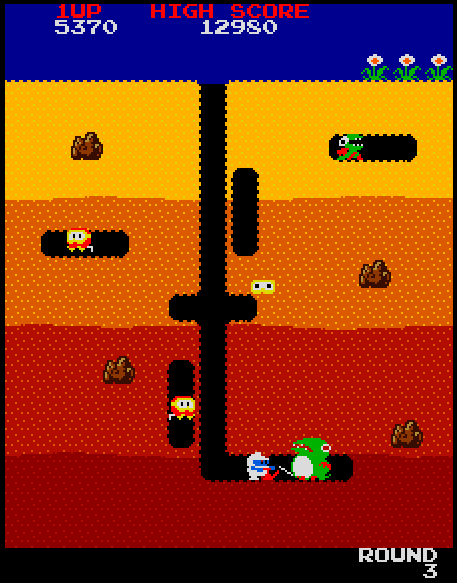
The game is very simple in practice, but there are a variety of ways to score higher points and reach the top of the scoreboard. There are several levels of dirt on the map, denoted by the different colors, and killing enemies at a lower dirt level will provide higher scores. Additionally, killing the Fygar while facing them horizontally will give a higher score than killing them vertically because a horizontal kill makes the player susceptible to the Fygar’s fire breathing attack. Digging under rocks so that they fall on the enemies will also give a higher score. Discovering these different scoring mechanics is part of the fun of Dig Dug and brings out a more competitive aspect to the game.
One of my favorite aspects of Dig Dug is the audio bits used in the game. Rouse makes no mention of the audio used in classic arcade games, but I would argue that it’s a very distinguishing feature of classic arcade games versus later generations of games. Much like the single screen gameplay mentioned by Rouse, these 8-bit and 16-bit pieces of audio were due to technological limitations. Despite these limitations, Dig Dug uses audio bits that are very enjoyable to listen to. The background music that plays while the player walks is one of my favorite aspects of Dig Dug. Digging tunnels and listening to the music is a very satisfying part of the game, and it’s what ultimately brings me back to playing Dig Dug years later.
 [Subject To Change]